Change Color

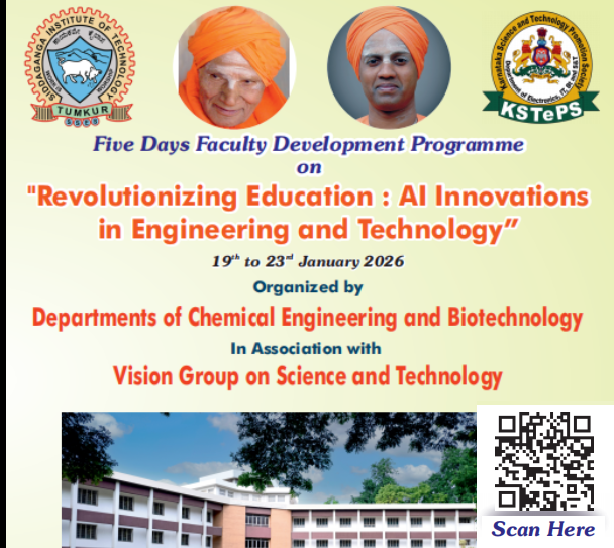
“Revolutionizing Education: AI Innovations in Engineering and Technology”
19th to 23rd January 2026
Siddaganga Institute of Technology, Tumakuru
We are pleased to invite faculty members, educators, researchers, and academicians to participate in the Five Days Faculty Development Programme on “Revolutionizing Education: AI Innovations in Engineering and Technology”, organized by the Departments of Chemical Engineering and Biotechnology, Siddaganga Institute of Technology, Tumakuru.
Program Details
- Date: 19th - 23rd January 2026
- Duration: 5 Days
- Venue: Seminar Hall, Department of Chemical Engineering & Biotechnology, Siddaganga Institute of Technology, Tumakuru
- Last Date of Registration: 10th January 2026
- Registration Fee: NIL / Free
Kindly register at the earliest to confirm your participation in this free Faculty Development Programme.
This FDP is designed to introduce educators to emerging AI tools and technologies, demonstrate real-world AI applications in Chemical Engineering, Biotechnology, and allied fields, and provide hands-on exposure to AI-based simulations, automation, visualization, and curriculum integration.
We look forward to your active participation.
About the Workshop
The Faculty Development Programme on “Revolutionizing Education: AI Innovations in Engineering and Technology” focuses on empowering educators with practical AI knowledge for teaching, research, automation, visualization, and curriculum integration. The programme especially emphasizes applications relevant to Chemical Engineering and Biotechnology.
About the Faculty Development Programme
Artificial Intelligence is transforming engineering and technology education by enhancing teaching, research, innovation, and interdisciplinary collaboration. This FDP aims to equip educators with practical knowledge of AI tools, applications, and pedagogical integration through expert sessions, hands-on activities, and industrial exposure.
Objectives
1. To introduce educators to emerging AI tools and technologies in engineering and technology.
2. To demonstrate real-world AI applications in Chemical Engineering, Biotechnology, and allied fields.
3. To provide hands-on experience using AI-based simulations and learning platforms.
4. To encourage the integration of AI into teaching and research.
Organizing Departments
Departments of Chemical Engineering and Biotechnology, Siddaganga Institute of Technology, Tumakuru.
About Siddaganga Institute of Technology
Siddaganga Institute of Technology (SIT), established in 1963, is one of the 121 institutions run by Sree Siddaganga Education Society (SSES). The institute offers 14 undergraduate and 6 postgraduate programs, with over 4,500 students presently enrolled. Renowned for academic excellence and values, most UG programs are accredited by NBA, and the institute holds NAAC’s ‘A++’ grade. SIT is consistently ranked among India’s top 100 engineering institutes in NIRF since 2016 and is ISO 9001:2015 certified.
Sixteen departments are recognized as Research Centres by Visvesvaraya Technological University (VTU), Belagavi, where 192 research scholars are pursuing their Ph.D. programmes. SIT became an autonomous college from 2007-08. The institute has 300 experienced faculty members, of whom 180 hold Ph.D.s from premier institutions such as IISc, IITs, and other reputed institutes, while another 50 faculty members are currently pursuing doctoral studies.
Faculty members are actively engaged in research in seven broad areas and have completed around 60 sponsored projects supported by various funding agencies, contributing significantly to research and innovation.
About the Department of Chemical Engineering
The Department of Chemical Engineering was established in 1974 and offers undergraduate program in B.E., postgraduate (M.Sc. Engineering by Research) and doctoral (Ph.D.) under the Visvesvaraya Technological University (VTU), Karnataka. Chemical Engineering at SIT is one of the earliest Chemical Engineering in the State Karnataka to offer both B.E. and M.Tech. programs in Chemical Engineering.
The department has core specializations in environmental remediation, advanced materials, biomedical engineering, alternative energy, reactor design, and nanotechnology. It has established collaborations with BARC, IIT Kanpur, and NIMHANS for research and development. With strong research credentials, the department has successfully completed projects funded by DBT, Lockheed Martin, Tata Trusts, DST, BRNS, SERB, ARVO-USA, NASUSA, VGST, and KCTU, and has produced impactful publications in leading journals.
With robust research credentials, the department has successfully completed projects funded by agencies like DBT, DST, SERB, BRNS, Tata Trusts, Lockheed Martin, VGST, and international organizations such as ARVO-USA and NAS-USA. The department has produced impactful research publications in leading national and international journals.
Vision
To be an internationally renowned department for Chemical Engineering education and research, meeting the aspirations of society
Mission
1. To impart quality education in Chemical Engineering at all levels.
2. To foster cutting-edge research and development in Chemical Engineering.
3. To produce responsible and ethical engineers to serve society.
About the Department of Biotechnology
The Department of Biotechnology was established in 2006 and offers undergraduate program in B.E., postgraduate (M.Sc. Engineering by Research) and doctoral (Ph.D.) under the Visvesvaraya Technological University (VTU), Karnataka. The department is recognized as a Research Centre in the year 2011. The department is committed to producing competent and ethically responsible biotechnology professionals.
Academic and research activities in the department span in the areas such as Bioinformatics, Molecular Biology, Fermentation Technology, Nanobiotechnology, Systems Biology, and Big Data Analytics. These thrust areas are supported by a team of six well-qualified and experienced faculty members whose expertise includes omics technologies, protein engineering, bioprocess engineering, nanobiotechnology, biomedical informatics, and translational biotechnology. The department has executed several sponsored research projects by funding organizations such as KBITs, VGST, DBT, DST, SERB, and VTU. It actively promotes Research and Innovations through industry collaboration and internships.
The department has received financial support from KBITs, Government of Karnataka, and other funding organizations for research, infrastructure development, and academic initiatives. The Department has it successfully offered one-year Postgraduate Diploma in Bioinformatics and Big Data Analytics, supported by KBITs and the Government of Karnataka in the past.
Vision
To be a center of excellence in education and research in Biotechnology to address the global challenges.
Mission
1. To offer industry relevant curriculum and research through industry collaborations.
2. To continuously upgrade the infrastructure to develop the facilities for training and
research.
3. To provide a good learning environment to help students imbibe professional ethics,
communication skills, team spirit and societal commitment.
Program Schedule for Five Days FDP on “Revolutionizing Education: AI Innovations in Engineering and Technology”
Day 1 – Foundations of AI, ML, and DL for Chemical and Biotech Educators – 19th January 2026
09:00 – 10:00: Programme Inauguration
10:00 – 11:30: AI as a Catalyst for Transforming Engineering and Biotechnology Education – Dr. Ravi Gudi
11:30 – 11:45: Tea/Coffee Break
11:45 – 01:15: Artificial Intelligence in Chemical Engineering – Dr. Ravi Gudi
01:15 – 02:15: Lunch Break
02:15 – 03:45: AI over Healthcare – Dr. S. Ruban
03:45 – 04:00: Tea/Coffee Break
04:00 – 05:30: Introduction to Artificial Intelligence, Machine Learning, and Deep Learning – Dr. M. A. Jayaram
Day 2 – AI Tools and Real-time Applications – 20th January 2026
09:00 – 11:00: Learning the Machine Learning for Process Plant Monitoring, Control and Optimization – Dr. Raghuraj Rao
11:00 – 11:15: Tea/Coffee Break
11:15 – 01:15: Learning the Machine Learning for Process Plant Monitoring, Control and Optimization – Dr. Raghuraj Rao
01:15 – 02:15: Lunch Break
02:15 – 03:45: AI-Powered Chemical Engineering Education – Dr. Manoj Kumar
03:45 – 04:00: Tea/Coffee Break
04:00 – 05:30: Hands-On NLP with Hugging Face – Dr. Manoj Kumar
Day 3 – Industrial Visit – 21st January 2026
09:00 am – 05:30 pm: Industrial Visit to INOX Air Products
Day 4 – AI Tools Transforming Education and Research Automation – 22nd January 2026
09:30 – 11:00: Designing Better Outputs: Prompt Engineering and Modern AI Tools – Mr. Shivaraj Karjagi
11:00 – 11:15: Break
11:15 – 12:45: Hands-On Session: Alpha Fold and Rose TTA Fold – Dr. Sanni Kumar
12:45 – 01:30: Lunch Break
01:30 – 03:00: AI in Chemical Engineering – Process Optimization, Simulation, and Fault Diagnosis – Mr. Kiran Raviprakash
03:00 – 04:30: Leveraging AI for Electrochemical Research, DFT Modeling – Dr. Gururaj Kudur
04:30 – 05:30: Manuscript Preparation – Dr. Gururaj Kudur
Day 5 – Visualization, Networking, and AI in Curricula – 23rd January 2026
09:30 – 11:00: Creating Professional Graphic Abstracts Using AI Tools – Dr. R. R. Siva Kiran
11:00 – 11:15: Break
11:15 – 12:45: Professional Graphs and Visualizations – Dr. R. R. Siva Kiran
12:45 – 01:30: Lunch Break
01:30 – 03:00: Build Your First Machine Learning Model – Dr. Ujwal Shreenag Meda
03:00 – 04:30: Data Visualization and Preprocessing – Dr. Ashwini B. P.
04:30 – 05:30: Valedictory Function & High Tea – Department of Chemical Engineering and Biotechnology
Key Highlights of the Workshop
AI Foundations for Educators: Core concepts in AI, ML, and DL tailored for Chemical Engineering and Biotechnology educators.
Hands-on Learning: Practical sessions on machine learning, NLP with Hugging Face, Alpha Fold, Rose TTA Fold, and data preprocessing.
Research Automation: Sessions on prompt engineering, manuscript preparation, electrochemical research, DFT modeling, and AI-enabled research workflows.
Industrial Exposure: Dedicated industrial visit to INOX Air Products.
Visualization and Curriculum Integration: Training on graphic abstracts, professional graphs, visualizations, and building machine learning models for academic applications.
Selected Speakers
Dr Ravi Gudi, Professor, Deputy Deputy Deputy Director (FIA), IIT Bombay
Dr S. Ruban, Dean, School of Engineering, St A School of Engineering, St Aloysius loysius (DEEMED TO BE UNIVERSITY)
Dr M. A. Jayaram, Professor, Rasta Center for food Technology, Bangalore
Dr. Raghuraj Rao, Founder Director and CTO, AKXA Tech Pvt. Ltd. Belagavi, Karnataka, raghuraj.rao@akxatech.com
Dr. Manoj Kumar, Department of Information Science and Engineering, NMIT, Bengaluru
Mr. Shivaraj Karjagi, Technical Consulting Engineer, AI Compute, Cisco
Dr. Sanni Kumar, Co-founder & Director, Biostica
Mr. Kiran Raviprakash, Honeywell
Dr. Gururaj Kudur, Department of Chemistry, NMIT, Bengaluru
Dr. R. R. Siva Kiran, Department of Chemical Engineering, MSRIT, Bengaluru
Dr. Ujwal Shreenag Meda, Dept. of Chemical Engineering, RVCE, Bangaluru
Dr. Ashwini B. P., Department of Computer Science and Engineering, SIT
Register Now
Participation is open to faculty members, researchers, and academicians interested in AI innovations in engineering and technology education.
Registration Fee: NIL / FREE
Registration Link:
Register Here
Last Date for Registration: 10th January 2026
Register early and reserve your place in this free five-day FDP.

ICARM Mission Statement

Our mission at the Interdisciplinary Center for Advanced Research Methods (ICARM) is to foster a culture of innovation and collaboration in research across diverse disciplines. We are dedicated to advancing the frontier of research methodologies, empowering scholars and practitioners to tackle complex challenges and drive forward the boundaries of knowledge and discovery. Through cutting-edge training, robust academic programs, and collaborative partnerships, we cultivate a dynamic ecosystem of inquiry where creativity and rigor converge to address pressing societal issues. At ICARM, we strive to be a catalyst for transformative research that has a positive and lasting impact on individuals, communities, and the world.
ICARM Objectives
1. Foster Interdisciplinary Collaboration: Promote collaboration and exchange of ideas among researchers from diverse disciplines to address complex challenges and advance knowledge.
2. Advance Research Methodologies: Continuously innovate and refine research methodologies to enhance the quality and impact of scholarly work across various fields.
3. Provide Cutting-edge Training: Offer comprehensive training programs and resources to equip scholars and practitioners with the skills and knowledge needed to excel in their research endeavors.
4. Support Professional Development: Facilitate the professional development of researchers by providing opportunities for networking, mentorship, and career advancement.
5. Promote Ethical Research Practices: Uphold the highest standards of ethics and integrity in research conduct and dissemination of findings.
6. Foster Global Collaboration: Cultivate partnerships and collaborations with international institutions and organizations to foster global research networks and initiatives.
7. Disseminate Research Findings: Facilitate the dissemination of research findings through publications, conferences, and other platforms to contribute to the advancement of knowledge and practice.
8. Address Societal Challenges: Harness the power of interdisciplinary research to address pressing societal challenges and contribute to positive social change.
Lifetime Membership Subscription
- Lifelong access to all services and resources.
- Exclusive discounts on courses and events.
- Priority access to programs and initiatives.
- Recognition for long-term commitment.
- Continued support from the organization.

Large Organizations/ Professional Societies

- Greater than 301 Employees
- Large Research Organizations
- Mutiple Branches/Corporate
- Large Educational Institutes
Government Organizations

- Government Departments
- Multiple Branches
- Multiple Services
- Multiple Government Organizations
- Single Point Contact
Be part of ICARM
Educational Institutions can Join Hands with ICARM